Short Stories
-
Accidents are not Possible
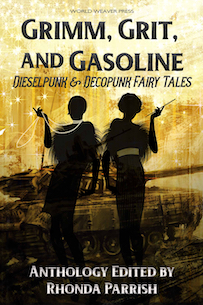
ACCIDENTS ARE NOT POSSIBLE, appearing in GRIMM, GRIT AND GASOLINE
Accidents are not Possible is a Hansel and Gretel retelling set during WWII, full of twins, special powers, and the dark side of eugenics. From World Weaver Press.
Dieselpunk and decopunk are alternative history re-imaginings of (roughly) the WWI and WWII eras: tales with the grit of roaring bombers and rumbling tanks, of ‘We Can Do It’ and old time gangsters, or with the glamour of flappers and Hollywood starlets, smoky jazz and speakeasies. The stories in this volume add fairy tales to the mix, transporting classic tales to this rich historical setting.
Two young women defy the devil with the power of friendship. The pilot of a talking plane discovers a woman who transforms into a swan every night and is pulled into a much more personal conflict than the war he’s already fighting. A pair of twins with special powers find themselves in Eva Braun’s custody and wrapped up in a nefarious plan. A team of female special agents must destroy a secret weapon–the spindle–before it can be deployed. Retellings of The Little Mermaid, Hansel and Gretel, Rapunzel, Cinderella, The Monkey King, Swan Lake, Pinocchio and more are all showcased alongside some original fairy tale-like stories.
Purchase on Amazon.ca Amazon.com or the Kobo eBook store
More information on Goodreads
-
Maggie of the Moss
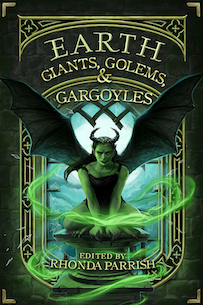
MAGGIE OF THE MOSS, appearing in EARTH: GIANTS, GOLEMS AND GARGOYLES
MAGGIE OF THE MOSS is a bittersweet tale with a woodland, folklore, and the theme of loss. From Tyche Books.
We come from dust, and to dust we return…
Earth is steady. Solid. Reliable. It is the source of life and the thing which sustains it. But it’s not always serene and peaceful. It takes a lot to stir the earth but when it does, things get dramatic. Quakes swallow cities. Oceans rise. Mountains crumble. Earth is not weak, and it knows no pity. Learn the strength of Earth and its creations in these eighteen stories, including: rusting dragons; mysterious summer jobs; magical inheritances; and dryads engaged in a bitter war.
Purchase on Amazon.ca Amazon.com or Apple Books
More information on Goodreads
-
The Last Sleep
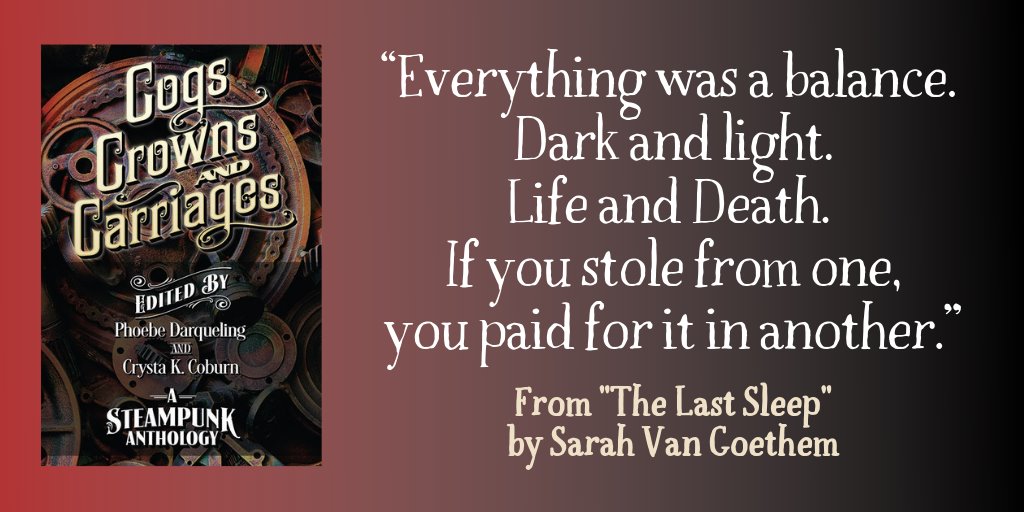
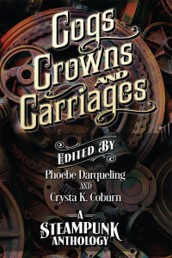
THE LAST SLEEP, appearing in COGS, CROWNS AND CARRIAGES.
THE LAST SLEEP is the tale of a post-mortem photographer who would do anything to save her little brother from dying of tuberculosis. Well…almost anything.For steampunk and Gaslamp fantasy fans!
If you aren’t familiar with Steampunk, here’s the skinny. The word “Steampunk” was coined in 1987 following in the footsteps of the Cyberpunk literary genre. It is a chance for writers to explore the futuristic past that never was, which includes mind-bending technologies, supernatural elements, and re-imagining the world during the height of the steam era. Some of our tales are set in fantasy lands, while others are firmly rooted in the real past but with their own twist.
Twelve international authors have come together to bring you a fresh collection of Steampunk and Gaslamp Fantasy inspired tales. Our stories range from light and comedic to dark and full of drama, so fans of the genre both old and new are bound to find something they love within these pages.
Purchase on Amazon as Paperback or Kindle eBook.
More information on Goodreads
-
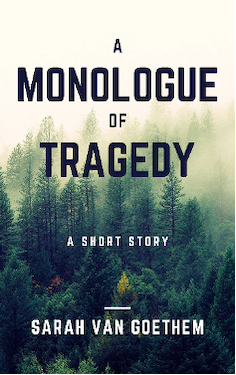
A Monologue of Tragedy
The dark forest was where it began, like in every other fairy tale, only the wicked was on the outside and I never knew it was there. The woodland was full of peeping creatures, thoughtfully watching me from inside hollow logs. Their idle chattering never told the truth. The stream trickled with the water of life, flowing past the big rock and into the river that wound around to a place I didn’t ask about. Out of the corner of my eye, fairies with bright green eyes matching the matt of lichen that spread over the trees, danced to a forgotten song.#
She came out of nowhere and everywhere. Her father was the breeze, a mere breath on my lips. I knew from the start, she wasn’t mine. Her hair was dark like the night sky over the forest, her eyes brown like the rich soil from which everything grew. She was only mine for safe-keeping, stolen from another place. I kept her in the forest for as long as I could, until the wind gusted, blowing us out. Sometimes I still notice the bark under my fingernails, from where I latched on.#
At first it wasn’t bad. I tried to recreate what we had. A row of saplings in the yard, transplanted trilliums in the garden. I pushed her on a swing, a hand-painted board tied to a branch with ropes. She sat on a unicorn and saw the sky through the leaves. She spent her days catching toads and riding her bicycle with streamers. When she skinned her knee, I pressed on a band-aid. Thanks, Mommy, she said. When she took a bath, I washed her hair. When she went to bed, I tucked her in. I told her stories of yesterday, of our time in the forest. In her tiny room with the single window, I spun tales of the time before and pulled the blind down on tomorrow. She still smelled like the first rainstorm in spring.#
It wasn’t long before she left. She looked too small; the steps on the yellow bus were as tall as her, the pack too heavy on her back. I was wrong, of course. She managed just fine. Every day her chubby hand waved goodbye and she went away to a world I wasn’t part of. It started slowly. She wanted to play on the computer after school, take a picture with my phone. It seemed harmless enough. But then she learned to read, to make shapes out of chaos. She looked out the big picture-window in the living room and saw all the way down the main street and out of our small town. Her eyes were better than mine. Where’s Daddy? I didn’t have an answer. “Here’s some playdough,” I said, offering her a mound of freshly mixed flour and salt. I’d dyed it with green and blue, the colors of the earth, and now it was a bright shade of aquamarine. I didn’t say anything when she nibbled on a piece. I expected her to spit it out.#
I went on a field trip with her when she was in grade three. It was only a small zoo but had a wide variety of animals including baboons, lions, zebras, and reptiles. At first, she was quiet. I thought maybe she didn’t feel well or had to use the bathroom. But when she saw the giant python in its glass home looking like a surreal Snow White, she trembled. When she started to cry, I led her away. Don’t look if it scares you. She ripped her hand out of mine and seared me with her eyes. He shouldn’t be in that small of a space, she hissed. Like I’d put him there. I held a hand to my chest like protection. Other kids turned to stare at her, parents frowned my way. I lifted my chin. We’ll look at the birds now. I clamped down on her wrist, dragged her to see the plumage of the male peacock. I felt the iridescent blue and green eyespots judging me. You’re doing it all wrong,they said. But then a green and brown hen walked up and the cock forgot me, bringing his tail feathers forward with a rustle. The boys are so much prettier, she said. She looked at me out of the corner of her eye. I didn’t satisfy her with a response. Instead, I said, He’s trying to court her. She rolled her eyes. I know. Her fingers were laced into the metal fence. She was reading the plaque. They’re supposed to live in the wild, in lowland forests. She caught my eye again, and this time the anger was gone, replaced with a sadness I knew all too well. They’re supposed to roost in trees at night. Now it was my turn. I know. I took her to the splashpad after that.#
She started a group to save the trees. I encouraged it. I wasn’t going to make the same mistake twice. She gathered her friends and I took them to the council meeting. It was packed that night; the community was divided. Tree-huggers versus farmers. Ethics against money. I thought there was no better fight than one led by children. Maybe she could achieve where I had failed. She bravely stood in front of the adults and told them the facts. That our area had less tree cover than any other in the province, that clear-cutting is destructive to water, soil, species, even our air quality. She shamed the councillors and the farmers in the room. I cheered for her, my warrior. She was fighting for the forest. She didn’t win. After the vote, she turned her eyes on me in disbelief. I’d been so sure she’d win. I didn’t have an answer for defeat, for a vote that blotted out the sun for her generation. Trees continued to fall and I watched it sour her. We consoled ourselves by planting more saplings out by the forest from which we’d come, our private utopia. Thankfully, the dark forest was immune to the clear-cutting. You couldn’t plant beans in a ravine or a stream. It was saved by dumb luck. She stepped into the forest when we were done and I held my breath, hoping she’d remember. She turned her phone toward herself and snapped a photo.#
She got her period and somehow that was my fault, too. I tried to make it a celebration. You’re a woman now. I’m aware of that, Mom. Wanna have ice cream? No, I want to figure out how these damn tampons work so I can go to the pool with my friends. She yelled and cursed, both to me and at me, through the bathroom door, sometimes throwing in a question (how in the eff does this work?) but mostly using swear words I usually forbade. I didn’t say anything this time. Fuck. Shit. What the hell. I poured myself a glass of wine and sat outside the door, unsure whether I wanted to laugh or cry, while she got acquainted with the workings of her own body. Finally, she emerged. She’d won this battle. But triumph was bittersweet. How long do I have to have this? she asked. I shrugged. Five days? A week? Maybe till you’re like fifty? I was guessing; I wasn’t sure myself. Eff, that’s like older than you. She walked out the door in a bikini and cut-off shorts. The wine made me bolder. Remember, you can get pregnant now! Like I’m going to bring a kid into this world.#
She outgrew me while I was making cookies in the kitchen. I tossed in chocolate chips, shoved the tray in the oven, and blinked. On the other side of the counter, she was suddenly taller than me. Or maybe I shrunk. Did you know the Golden Toad was the first species to go extinct due to climate change? she asked me, but I knew it wasn’t a question. She knew I didn’t know that. She took a spoon of the raw batter and ate it. She also knew I hated when she did that. She knew a lot of things. Too many. The cookies will be done soon, I told her. You can wait five minutes. She was a huge fan of sarcasm now. I’m more likely to die of a rapidly spreading disease than food poisoning. I’m sure she wasn’t wrong. Somehow that was the day we really moved into the present.#
Her world is bigger than mine now, connected by the fingertips. She’s a sponge, absorbing, then leaking. At first it was only a dribble, but now reality spills from her lips, violently squeezed out. I think she was born to battle. She tells me the oceans are full of parasitic plastic, islands of garbage that choke fish and birds. Honeybees are vanishing, taking all the sweetness. The earth is warming, glaciers are retreating. She says sea levels are rising, submerging us in our own stupidity.We’ll drown, Mother. She speaks of ice with fire in her eyes. She says it’s ironic; some will drown and yet others will die of thirst. Water cycles are all affected. Forests are being harvested, more than just the ones in our area. Farmland is increasing along with a population bent on destroying the planet. There’s accusation in her tone, blame in her muddied eyes. The generation she speaks of is mine. I failed her. She goes on and on, a monologue of tragedy, a world I never wanted for her. She says trees extract groundwater from their roots and release it into the atmosphere. I try to tell her I knew this from my time in the forest; the shimmers of light that flickered through the branches. The place she’s forgotten. She hastily jerks me back from the treetops; the trees are now piles of brush, she says, ready to be lit.And the rows of corn lead to the end. Oxygen levels are going down. We’ll suffocate, Mother. I already knew it was harder to breathe.#
I let her go on a mission trip. She thinks she can save the world with a privileged-kids-vacation, with a snapchat of her teaching English or petting turtles. She gives herself a pat on the back and a trophy because she cares more than her peers do. She isn’t them, the ones who take pictures of their butts and cleavage and spread their legs like icing on a cake. She thinks she’s above that. Maybe she is. Sometimes she’s still the little girl who wants the python released. But other times I catch her looking at her own butt in the mirror. At least she only takes photos of her face. Twenty a day, I’d say, on average. Put your phone down. It’s like heroine to you, an addiction. Sometimes I take it from her; it’s the best punishment, the severing of the lifeline. She thinks she’s dying, like I chopped off a limb. She tantrums worse than when we left the forest, writhes in agony. No one died, I remind her.It’s just a phone. It doesn’t escape me that I’m the one who pays for it. I wish I could lock her in the dark forest, far away from reception.#
She slaves away for her good marks in science and math. She’s applying to university in the fall, she’s getting the hell out of here. She wants to go into environmental science. Save the whole world, not just our forest. Maybe she’ll win yet.#
My parents recently sold the dark forest. It went with the farm, like an organ to a body. The heart, I think. Somehow, I said goodbye to the big rock, the lumberjacks and the forest fairies. The place I first dreamt of her. I only hope on the future battlefield, she’ll remember where she came from. -
In The End
The mirror lied. She knew it without the gift of sight.
You’re still the fairest.
Maybe it was a good thing she could barely see anymore, her eighty year old eyes would tell her the deceit, with wrinkles drawing paths, indentations of a falsehood that wasn’t her. Instead she saw shapes and purple blobs, and shadows of memories.
“Do you know who this is?” she had asked her granddaughter last week, maybe a month ago, it was hard to tell, days were mostly the same, and she had shoved her wedding photo into the waiting hands. “Of course,” was the reply, tinged with a melancholy, and it was the truth, of course she knew, but she needed to know again. The flawless skin. The shining hair. The smile that had been her.
The life.
I know what you are about.
All those children.
Her mother. With the dark chocolate eyes, and the almost black hair, her nails worn down and her skin scrubbed red. Sacrifice. Thirty-two children. Not all at once, but through years of fostering, years with her heart entwined with ropes, knotted in every direction and pulled taut. Not just her mother’s babies, but hers too, her hands to hold, her love to give. Her loss.
Her pain.
Her father. Her ears ringing with the sounds in the street and her bare feet cold on the cement, the ominous feeling of knowing before you possibly can, the crushing of her chest, her own heartbeat reminding her she was alive and her father wasn’t, his motorcycle lying on the ground just down the street. Her eyes. They saw back then.
I see you still.
Freedom. The pond. Those were the days. The air hanging on her thickly, her short bobbed curls twisting into her neck, wet with perspiration. Her cousin’s dress and her own flung into the bushes and the sweet coolness of the water, the absolute serenity, the bareness of soul with body. And then rustling in the bushes and male laughter. And stolen clothes.
Stolen life.
Is this what’s it like when you’re ready?
Had she been ready to marry him? Her prince. Tall and lean, his blue eyes clear, proposing a future of possibilities, her potential, his promises. Their life. Yes. His foundation, for over half a century, sometimes crumbling, sometimes rebuilt, always there. Yes. She wanted him. She wanted him then, her tiny figure engulfed in his strong arms, with the delight of young love, with pure abandon, with no thought of conclusion. She wanted him later with his thinning hair, with his sunspots, with his fake tooth that clicked in and out, with a deeper love borne in conscious thought of an ending.
Unimaginable.
You still wear the glass slipper.
She kept giving away items, trinkets, furniture, clothes. “Take it,” she’d say, “I no longer need it.” And maybe she would tell them the story behind it, where it came from, whose it was, and hope they would remember, because that’s all that really mattered in the end wasn’t it? Not the cross-stitch hanging on the wall, but the fact that someone had taken the time to intricately embroider each thread into place, to take tiny pieces of colour and uniformly group them onto the evenweave and somehow make a whole.
You are still whole.
The first baby came early. Eight months after the wedding. She had the big chocolate eyes, just like her grandmother’s, and the circle closed in a bit. There were three more after that, over the years, tight little fists clutching her apron, days that seemed interminably long, years that blinked and beckoned as they fluttered by before the house sat silent and the apron hung on the hook in both relief and retrospect.
And then the grandchildren. One after another. Gingersnaps and creamsicles and ice cream floats on the front porch. More pieces of the puzzle, each fragment fitting into place, revealing more of the overall image. Resemblances revealed once more, similarities unfolded. Familiar mannerisms and recognizable eyes and noses. The story continued.
They always came to her in times of need. They always thought it was their own need, to talk to her, to receive some advice, to have her listen. But she found that she would undoubtedly find herself sitting across from one of them, pouring out their hearts in hopes of enlightenment, to find that it was actually her need being fulfilled. Silently she would nod in acknowledgement. The signs were there. But you had to look for them.
“Time to turn the page,” is what she would always tell them when things were tough, when life didn’t always give you what you thought and expected. “It’s a new chapter.” But at some point…there is an end to the book. Isn’t there always an ending?
Yes. Happily Ever After.
Her liver. A betrayal, like her eyes. The word transplant, it dangles on her cracked lips still, her dirty word and her victory. Her nightmare while waking, her scars a reminder, never again. An organ not her own, a whole body no longer hers, rejection follows her everywhere, she stays only slightly ahead of it and sometimes even throws it breadcrumbs now to mark the path.
Use pebbles.
She walked to the forest not long ago. All the way to the back of the field, down into the valley, amongst the pine trees. Her granddaughter’s husband’s ashes are buried there, she likes to put fresh flowers on his stone. How is she still here? How was he taken so young, and here she is, forcing her weary bones to move on? Faith. She survives on faith and she knows it. She walked to the river next, lost in thought. Or maybe just lost? The summer heat didn’t bother her, nor did the mosquitos. Her blood wasn’t good enough for them anymore. Somehow time got away from her and when she blinked again there was a police officer escorting her back, and a search party and concerned family and friends. Anger engulfed her then. Loss of independence makes the other losses seem less somehow.
She was glad she had gone. Turned out it was her last walk. Not long after, her bones gave up on her too. She had known the osteoporosis would catch up with her. A fracture in the fifth lumbar they said. The morphine made things seem less real, or maybe sometimes more real, it was hard to tell. Her bones had never been good, she remembered breaking the same leg twice as a young girl. Always wishing the days to go faster as she laid on the sofa waiting to heal. Would she heal this time? Or was this it? Was this life now? Lying in her bed, in what used to be the den, but was now her bedroom since she couldn’t climb the stairs in the old farmhouse.
The turret was lonely anyway.
Her daughters would help her into her nightie and tuck her into bed now. And she would tell herself that the den was fine, she liked the rose carpet and the lace curtains, she had decorated it herself after all. But it wasn’t enough. She wanted to go upstairs again to her bedroom. She wanted her life back. Or did she? She pulled the blankets up to her chin and tried to be brave. She would cry on her own time. When it was dark she would have her moment, lying in bed by herself. And though she couldn’t see, she knew all the pictures on the wall above her by memory. All the black and white photos of those who were no longer here, of those she loved, of times long gone. She could always feel their presence. Sometimes closer now.
Such betrayal. Her body.
You still have your mind. Wherever it takes you.
They told her that her short term memory was going too. But that was okay, they said, her daughters, the ones who kept coming over. They didn’t mind telling her things again. But it wasn’t okay, not to her. Her memories sustained her, like a deep breath. Inhale. Exhale slowly. Say thank-you that you woke up this morning (that’s the advice she always gave them.) Because someday it will be your last day.
The end.
Or the beginning?
A circle has neither.
A story has both.
-
In Your Eyes
One of us is dying.
It’s inevitable.
Not like when you ‘accidentally’ got me pregnant when we were twenty. We couldhave actually prevented that, but I guess if I had to choose, if I had to go back in time, I wouldn’t avoid that, because we have her now. We have three of them now. The point is, we could have prevented that. But that’s different than this.
If there was a way to thwart this, I don’t know what it was.
And now we’re dying.
The nurse comes to the house now, it’s gotten that bad. I can’t tell which one of us she doesn’t trust, but I can see it in her eyes, when she asks the questions and knows our answers will be different. And she nods her head and her voice is all sweet and syrupy and her eyes sympathetic and I think you like her more than you like me these days and I have to find a reason to follow her to her car and tell her privately how you lied. How you tell her you’re fine when you aren’t. But then she turns it around and asks how I am, no really, how am I doing? Like it matters.
You even lie to yourself.
But not me. I’m honest to a fault. And it’s killing me. The knowing. While you dither your day away in a state of denial, I wallow in the facts, the statistics, the horror of the situation. And at night, when I finally try to find peace in the ritual of sleep, you pace the floor, step after step, one step closer to death’s door. The darkness of night brings reality to you, and you cling to me, you clutch at me like you’re drowning, but the swells are too much, and I can’t save you, and you’re pulling me under. And the terror in your eyes is in my heart.
My hands are going numb sometimes, like pins and needles, they fall asleep and I clench them and try to make them come back to life. My right leg feels the same, heavy and hollow and it scares the shit out of me and I jump on the kid’s trampoline in the backyard until I collapse because I can barely breathe any longer. And then I lay there laughing because this doesn’t happen to young people that have a whole life yet to live. It’s ludicrous.
We said “I do,” at the church where both my grandparents and my parents were married, a tradition passed down. And I wore the white lacy dress with the crinoline underneath and flowers in my hair and I saw in your eyes that I was beautiful. And my grandparents were there, and my parents, all together still, which I suppose is almost peculiar in the grand scheme of things, but it fed my expectation that we would be together until we were old. And I said “in sickness and in health,” but I didn’t know what I said; I didn’t know that the sickness portion could be a reality so soon. And I feel betrayed now, deceived by unrealized opportunities. Or maybe by you. Or maybe just myself.
The children will be orphans if we both die. That thought makes me panicky, makes my heart beat faster and my palms go sweaty, and when I pass you in the hallway sometimes I glare at you, because I am just so sick and tired of it all and I didn’t ask for this and neither did you, but there’s no one to blame and anger is a funny thing when there’s no direction for it. And in your eyes is sorrow, and I see me, oppressive and hard-hearted, but even I know its self-preservation, a means of survival.
And then I feel guilty. Embarrassed by my own fallibility, my failures at being a worthy caregiver, in short, by being human. But you’re mean sometimes too, maybe not quite mean, but something like that, something unpleasant. Something that shuts us out, the kids and I, like a veil between your world and ours, like you’d rather be alone, like you’re pulling away from us. Maybe that’s the way it has to be. We each die in our own way.
But other times, oh other times, the memories of our youth, so fresh on our heels, the remembrances of our free times, of laughter and your strong arms around me, my refuge and protection against the world, makes me place my hand on your head and beg God to take it all away. And the look in your eyes, the absolute tenderness that lets me know I am your dearest of all, and that you know I would give just about anything to make it go away, to have you back, to separate you and it. Because it doesn’t seem right that you are made to endure this. That I am made to suffer this too.
The diagnosis was given to us like a head on collision. No matter the sterile room, the ageing oncologist with his white hair and round glasses, the controlled environment and structured setting. No preparation could ever be enough for a glioblastoma, a deadliest of brain cancers, a havoc-wreaking tumour with the sophistication of a lady and the shrewd cunning of a mad- scientist. Something so complex and multifaceted that they offer us no hope. On the paper in black and white: Prognosis, one year. And here we are, after the crash, in critical condition, both of us with life-threatening injuries.
And you ask me, in all earnestness, with no jealousy, with only love in your eyes, if I think I will find someone else after? And how do I answer that? It’s a question lacking an answer, because I don’t know the future, I don’t know anything except the gravity of the situation right now. But you answer it yourself, with a kindness outside of my current understanding, and I know in this moment that it’s you who is dying, and not me.
“I want you to,” you say, and tears fall from your eyes and streak your cheeks and your head is in my hands and I kiss the tears away, and I know my heart has broken and there is no repair.
And I lay in the hospital bed with you as the end is nearing, and I am curled up in your arms, like in the beginning, like how we started out, only then we stared up at a blue sky and a future of castles in the clouds, and now I stare at fluorescent lighting and tiled ceilings on my own because your eyes are shut and you are sleeping. My auburn hair cascades over your arm and I pull that arm around me tighter because it doesn’t do your bidding any longer. Nor does your leg on the same side, or your speech for that matter. But when you open your eyes they are as blue as always, unchanged, like the sky and the ocean, and in them I see me, scarred and broken, and I’m uncertain again as to which one of us is dying. So I sacrifice myself.
“It’s okay,” I tell you, “You can go.”
It’s what I’m supposed to do, I read that in the books, the ones that tell you what it’s like at the end, because I have to know, I can’t have any more surprises. But I know that I mean what I say, because there is no life here anymore, not like this.
“Whatever’s out there, it’s got to be better than this,” I tell you, and I know you’re scared, but you nod your head, and I see acceptance in your eyes. Yours and mine.
I tell you I love you, and you say “LOVE. YOU,” back. And it’s halted and thick and I know it takes effort, but I never forget it.
Your eyes close then, never to reopen. Sealed is the mirror to my soul. Your feet grow cold, I know because I lift the blankets and touch them and the life is going out of you, first at the limbs and working its way up to your core. Your breathing gets slower and further apart, and the last one comes in a gasp and the exhale pours out long and empty, and that is all. Except the crying I hear, sorrowful sobbing which haunts my dreams still, the weeping of the dead, which apparently, belongs to me.
It was you who died. In the end, the rational and reasonable answer is that you died. I watched it happen and somehow sight makes things more real. Feelings, emotions, aren’t given as much validation. If they were, then I died with you.
And somewhere we are dancing in the rainbows, in a ribbon of light that flows through the blue of your eyes. The place I always saw me.